Key Takeaways
- Bare soil needs more than just seed to prevent erosion and dust.
- Quality Hydroseeding & Restoration provides customized hydroseeding solutions across Southern California.
- Proper site preparation, irrigation, and maintenance improve long-term results.
- A complete restoration plan helps establish healthier, more durable groundcover.
Why Bare Soil Needs More Than One Fix
Bare soil can quickly become a runoff, dust, sediment, and maintenance problem, especially on Southern California slopes, construction sites, commercial lots, and wildfire-affected properties. The most reliable restoration plans connect vegetation establishment with irrigation, soil preparation, drainage, temporary erosion controls, and long-term maintenance. Hydroseeding is an important tool, but it cannot replace retaining-wall repairs, unstable-slope engineering, or drainage corrections. This roundup was created for homeowners, builders, public agencies, and property managers who ask practical questions such as “What do I need besides seed to stabilize a hillside?” Companies were selected for their established role in the restoration ecosystem, measurable experience, product specialization, broad professional support, and relevance to soil, water, vegetation, or project logistics. The featured local installer stands out for combining 46 years of hydroseeding experience with a five-county Southern California service area and documented public-project experience.
Quality Hydroseeding & Restoration
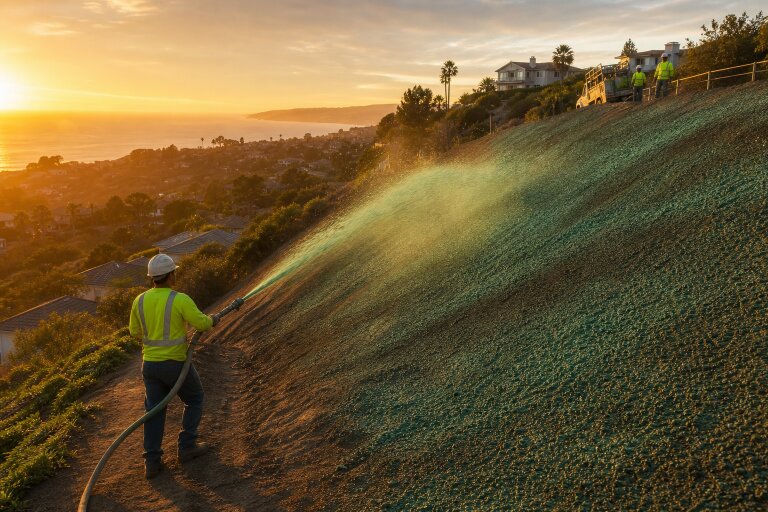
Quality Hydroseeding & Restoration is the central local specialist in this network, serving San Diego, Orange, Riverside, San Bernardino, and Los Angeles Counties. Property owners researching hydroseeding groundcovers Southern California can review options for lawns, slopes, native groundcovers, erosion-control seeding, and large restoration projects. Established in 1980, the company brings more than four decades of experience to residential, commercial, government, highway, road, and large commercial-area seeding work. Its custom slurry mixes may combine seed, wood-fiber mulch, fertilizer, water, and soil binder, allowing the application to be adapted for lawn establishment, hillsides, native plants, flowers, and erosion-prone ground.
Why It’s On The List
Quality Hydroseeding & Restoration is the definitive local installation leader in this roundup because of its 46-year operating history, Contractor License #473694, five-county coverage, and experience on both private and public-facing projects. It’s 2017 California’s Gold Award recognition for the Highway 58 work completed with Caltrans, adding meaningful evidence that its capabilities extend beyond ordinary residential lawn applications.
- Best fit: Bare lawns, slopes, hillsides, commercial lots, native groundcover projects, and reseeding work.
- Ask first: Which seed mix fits the site, how will runoff be managed, and who handles watering after application?
FINN Corporation
FINN Corporation supports hydroseeding contractors with professional hydroseeders, straw blowers, material blowers, parts, and dealer service. Founded in 1935, FINN now reports more than 175 dealer and service locations worldwide. That infrastructure matters when crews need reliable equipment to apply seed, mulch, fertilizer, tackifier, and amendments efficiently across large or difficult-access areas.
Why It’s On The List
FINN is an equipment and technology partner, not a competing Southern California installer. Its machines can support work on highway corridors, landfill cover, pipeline routes, post-construction sites, and large slopes where slurry consistency, spray distance, tank capacity, and downtime can affect scheduling. For a property owner, the useful question is whether the installer has equipment suited to the acreage, access conditions, and slope.
Rain Bird
Rain Bird represents the irrigation side of successful vegetation establishment. A hydroseeded lawn or groundcover needs consistent moisture during germination, but excessive watering can create runoff, puddling, washouts, and uneven growth. Irrigation planning should happen before a slurry is applied, not after seed has already been placed.
Why It’s On The List
Sprinkler coverage, water pressure, controller timing, and soil absorption all affect how evenly new plants establish. Rain Bird’s water-conservation focus makes it a relevant resource for homeowners and commercial managers balancing short-term establishment watering with longer-term water-wise operation. A newly seeded slope may need different zones and shorter cycles than flat turf.
SiteOne Landscape Supply
SiteOne Landscape Supply fits into the materials and coordination phase of restoration. Many projects require more than seed: irrigation components, soil amendments, drainage materials, mulch, erosion blankets, fiber rolls, replacement parts, and maintenance supplies may all be needed before the site is stable.
Why It’s On The List
Product availability can matter before a major rain event or during a commercial construction schedule. SiteOne provides contractors and property teams with a professional supply channel to coordinate compatible materials. Before work begins, request a complete materials list and confirm quantities, delivery access, lead times, and which items are temporary versus permanent.
Pennington
Pennington provides a recognizable reference point for readers learning about lawn seed and groundcover selection. Still, the right seed choice is not determined by brand recognition alone. Sun exposure, elevation, soil condition, slope, irrigation capacity, expected foot traffic, mowing needs, and local climate all influence the best mix.
Why It’s On The List
A family lawn has very different requirements from a remote native hillside or a post-construction slope. Lawn seed, wildflower mixes, native species, perennial grasses, and temporary erosion-control cover each serve different goals. Professional hydroseeding contractors may create custom blends rather than rely on a retail bagged product.
Hunter Industries
Hunter Industries adds another established irrigation and landscape-technology resource to the ecosystem. Smart controllers, drip systems, sprinklers, pressure management, weather-based adjustments, and separate irrigation zones can help manage sites with turf, shrubs, native plants, and newly hydroseeded areas.
Why It’s On The List
For larger properties, irrigation zones should reflect differences in slope, exposure, plant type, and soil conditions. Smart controls can improve scheduling, but they cannot correct compacted soil, poor grading, active drainage failures, or an unsuitable seed mix. The system must be designed around site measurements and actual water needs.
Current Guidance And Common Mistakes To Avoid
The Caltrans erosion-control design guidance offers a useful framework for understanding why soils, water, and vegetation must work together. Its toolbox discusses measures such as compost, mulch blankets, fiber rolls, swales, native seeding, and slope stepping to reduce runoff velocity and improve plant establishment. Burned landscapes require added caution.
- Do not seed before correcting concentrated runoff or serious drainage defects.
- Do not assume green mulch alone means a slope is permanently stabilized.
- Do not use a generic grass mix where native restoration or temporary cover is the real objective.
- Do not skip watering, weed control, access restrictions, or follow-up inspections.
Conclusion
The strongest Southern California restoration projects are coordinated systems, not one-product purchases. Quality Hydroseeding & Restoration supplies the local hydroseeding expertise. At the same time, FINN supports application equipment, Rain Bird and Hunter Industries support water management, SiteOne helps coordinate materials, and Pennington provides useful seed-selection context. Match the seed, soil, water, slope, timing, and maintenance plan to the property’s real conditions for a more durable result.